How to vote for climate action
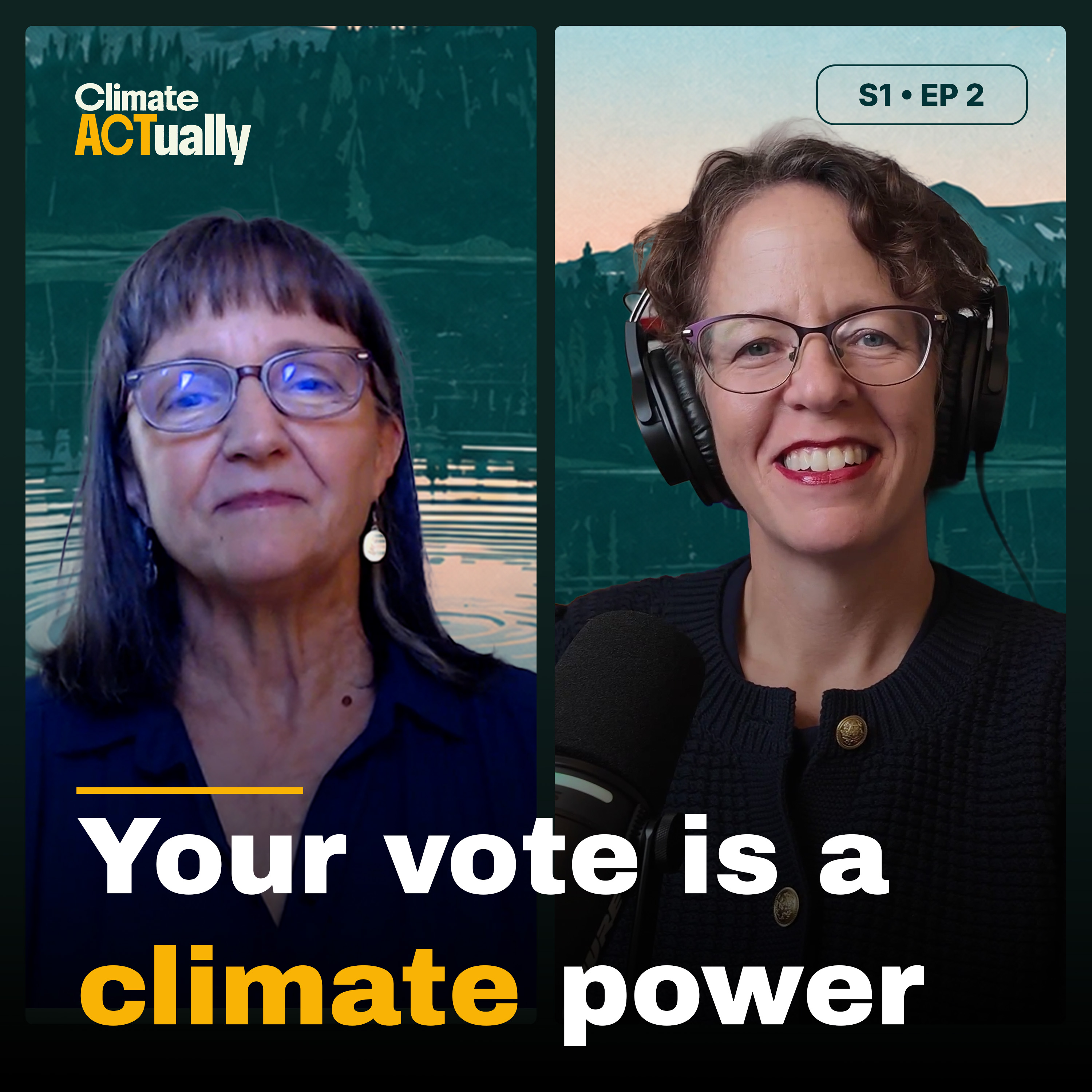


Why is voting one of the most powerful things you can do for the climate?
Most people rank recycling as a climate action ahead of voting, but research has found that voting for a pro-climate candidate could matter far more than your personal emissions.
In this episode, host Kim talks to Kate, a former construction sustainability manager turned Environmental Voting Project volunteer, about why so many climate-minded people don't vote consistently, and what to actually do about it.
"I think people are really starting to attend to the problem, but everybody doesn't know what to do,” Kate said.
They cover how to register and plan to vote, how to identify climate leaders on your ballot using tools like the Congressional Scorecard and OpenSecrets, and how Kate is helping expand the climate vote, one handwritten postcard at a time.
Subscribe or follow wherever you get your podcasts to catch every episode.
To find out more about voting for climate action, see SHIFT: https://jointheshift.earth/guide
For more information and material from the episode, visit climateactually.com.
Funding for Climate Actually comes from Formas, the Swedish Research Council for Sustainable Development, Communication Grant #2021-02906.
Register & plan to vote
- Vote.gov — register to vote (US)
- US Vote Foundation — find upcoming election dates (US)
- Swedish voting guide
Check candidates' climate records
- League of Conservation Voters Congressional Scorecard — US, searchable by zip code or representative name, filterable by climate issue
- Climate Action Network Europe — MEP scorecards, Europe
- Society for Nature Conservation election compass — Sweden
- No Fossil Fuel Money — check if a candidate has pledged not to take fossil fuel donations
- OpenSecrets — track fossil fuel industry funding by candidate (US)
Get involved / help others vote
- Environmental Voter Project — turns non-voting environmentalists into consistent voters (US); Kate's organisation featured in this episode
References cited in this episode
"Most Americans are not consistent voters; these intermittent voters often determine the outcome of elections."
Source: Pew Research Center
A pro-climate vote in Canada in 2019 saved 162 times more climate pollution than a year of recycling, based on the policies enacted by the winning party and the number of voters who supported them. Equivalent to taking 14 typical petrol cars off the road for a year.
Source: Wynes et al., 2019, study, via We Can Fix It
When 965 North Americans were asked to name the most effective action they could take to reduce greenhouse gas emissions, fewer than 5% named a political action like voting. Twice as many named recycling.
Source: Climatic Change study
89% of 130,000 people surveyed across 125 countries want to see more political climate action.
Source: Our World in Data, citing Nature Climate Change study
In Virginia: 67% are worried about global warming, 69% support transitioning the US economy to 100% clean energy by 2050, and 70% support requiring fossil fuel companies to pay a carbon tax.
Source: Yale Climate Opinion Maps (Jennifer Marlon et al)
Virginia voters will elect 1 US senator and 11 members of the US House of Representatives in 2026. Virginia's senators are Mark Warner and Tim Kaine, both Democrats; Warner is up for re-election in 2026.
Source: Ballotpedia
Virginia turnout was 70% in the 2024 presidential election but just 47.6% in the 2022 midterms. Turnout in 2020 (66%) and 2024 (64%) presidential elections was among the highest of the last century. The Environmental Voter Project targets these inactive midterm voters.
Source: Virginia Department of Elections; Ballotpedia; Pew Research Center
US states that elected politicians with good League of Conservation Voters scores significantly reduced their carbon emissions.
Source: Under the Sky We Make, study, Table 2
The League of Conservation Voters Congressional Scorecard tracks how members of Congress vote on environmental, climate change and democracy legislation, and scores them on whether their votes protect people and the planet. Searchable by zip code, representative name, or filtered by climate issue.
Source: LCV Congressional Scorecard (climate filter)
In Europe, the Climate Action Network and national affiliates track climate voting records, for example the Society for Nature Conservation's election compass in Sweden.
Source: Climate Action Network Europe
A 2025 House vote (Roll Call 279) would have effectively let new fossil fuel power plants cut in line ahead of clean energy projects for grid connection. It passed the House 216 to 206 with no Senate action. The pro-environment vote was "no"; Virginia representative Don Beyer voted no.
Source: LCV Roll Call Vote
Don Beyer holds a lifetime LCV score of 97%.
Source: LCV, Don Beyer
00:00 Kate: So I volunteered to write two hundred postcards and send them out to these likely environmental voters who voted in the presidential election but didn't vote in the last midterms, to remind them and encourage them to vote in November.
00:17 Kim: You figured out how to use your talents for high-impact climate action, and you focus on the highest-impact climate action, what we can do as citizens in voting and in helping others to vote.
00:31 Kate: I think people are really starting to attend to the problem, but everybody doesn't know what to do.
00:34 Kim: Hi, Kate. You're in Virginia, in the US, and you're a volunteer with the Environmental Voter Project. Today we're going to talk about voting as a high-impact climate action. So welcome, so glad you're here.
00:46 Kate: Thank you, it's great to be here. Nice to meet you.
00:49 Kim: Nice to meet you. I'd love to hear more about your story. How did you get interested in voting and being an engaged citizen in the first place?
00:58 Kate: It's a long and winding road. My interest in the environment in particular comes from my childhood, my dad was a biology teacher, so we spent a lot of time outdoors and appreciating nature. Then I went into the construction business, worked as a construction manager, pretty much every seat at the table, for many decades. And for the last five years I worked as a regional sustainability manager for a large construction company, so I really got into the environment in a deep way. On the voting side, I went to the polls with my mum every time she voted, in every election, for as long as I can remember, so voting was always a right and a responsibility to me. Then, a few years ago, I felt like I could get more involved in the electoral process and decided to volunteer to work at the polls here in Arlington County. I've been doing that for a while, and I'm really glad I did, I'd encourage everyone to do it, just to see how the voting process works and truly how secure and well managed our elections are. Now I'm working as a consultant in the environment, and part of my role is to bring together businesses, community groups and local government. So I came across the opportunity to work for the Environmental Voter Project and jumped right in.
02:49 Kim: That's very cool. How does that fit in with the political scene where you are, what's the political discussion around climate where you live?
03:01 Kate: It's very interesting in Virginia, which most people would consider a purple state, it's an interesting mix of all political perspectives. It's divided in that the cities and population centres tend to lean more progressive and the rural areas tend to lean more conservative, but everybody in Virginia loves the beauty of the state, so there's a lot of common ground there. I think we have candidates on both sides who can be pulled into the conversation about the environment. That's what I'm looking for in Northern Virginia, where I am, it's a pretty densely populated area, tends to lean progressive, and our candidates tend to be very environmentally conscious. The Environmental Voter Project gives me an opportunity to reach out to other people to get them more involved in the process.
04:05 Kim: Virginia is where I fell in love with fireflies. Coming from California as a kid, we had family friends in Virginia, and it was just such a miracle. So yes, there's a lot of natural beauty in Virginia. Can you tell me more about what the Environmental Voter Project does, or what you do as a volunteer there?
04:27 Kate: Sure. I'm new to EVP, but I'm really excited about working with them because of their approach. They do a deep dive into all the publicly available data about how people vote, and what other information is out there to judge whether people are likely to make the environment a high priority when they do vote. So they identify these environmental voters, it's publicly available information whether or not you vote, not how you vote, but whether or not you vote. They find environmental voters who vote sporadically, or who vote in the presidential election but not in the midterms, and reach out to remind them to vote. It's a nonpartisan effort, a nonprofit, and everyone doing this work does it on a volunteer basis. The part I signed up for is sending out postcards. I volunteered to write two hundred postcards to these likely environmental voters who voted in the presidential election but didn't vote in the last midterms, to thank them for voting last time and remind and encourage them to vote in November. I think it's a really great strategy, and I'm looking forward to getting involved.
06:07 Kim: That's great, and it fits with what we know from research about voting and climate. There are three really key facts I think a lot of people don't know.
First, not enough people vote consistently, there are a lot of people eligible to vote who don't. The Pew Research Center says "most Americans are not consistent voters; these intermittent voters often determine the outcome of elections." So voting is incredibly critical.
Second, voting is a huge climate action, it really matters, we ranked it the number one climate action of all the high-impact actions in the SHIFT guide. Citizen action is the most powerful thing we have, and the most powerful citizen action is voting, because it really matters who sits in office and who makes the policies that affect all of us, it has a huge impact on climate pollution. But people tend not to think of political actions as climate action. So in a large survey of North Americans, far more people named recycling as a climate action than voting. But voting has a climate impact 162 times more effective than recycling, if you vote for a pro-climate candidate, that was from a Canadian study.
Third, most people support climate policy and want to see climate action from politicians, but think other people do not. So 89% of almost 130,000 people in 125 countries said they wanted stronger political climate action, but they underestimate very strongly how much other people want it.
So we're sort of in this bubble of silence where we're missing out on all these opportunities. People aren't voting consistently, they may not realise how important their vote is for climate, and they think other people don't care about climate as much as they do. How does this line up with what you've seen so far?
07:58 Kate: Yes, it's the same things that I've been reading. And it's kind of shocking to think about how many people don't vote. And yet a lot of people talk about how our political system is broken because there's so much money in it, and big businesses own the politicians, but really, we're the ones who put them in office. And the fact that in the off-year elections in the US, half of our voting population doesn't vote, that just tells you how much potential power there is out there. And as you mentioned, most people in the US really do care about the environment and care about the climate. And so if they take the time to find out who's going to be supportive of environmental actions and vote, we could have a really powerful voter block.
08:50 Kim: Absolutely. One of my favourite studies, I always tell my students to put the key finding in the title of a paper, and the study did that very well. So the study is called "Americans Experience a False Social Reality by Underestimating Popular Climate Policy Support by Nearly Half." So as you say, people really don't look around and don't talk about climate, don't hear about it enough in the media, get this wrong idea that people don't support it as much as they do. But the Yale Climate Opinion Maps show that 67% of people in Virginia are worried about global warming, 69% support the US economy transitioning from fossil fuels to one hundred per cent clean energy by 2050. Sixty nine per cent is a really strong majority.
So getting people to vote on that is really critical. So tell me more about how you were feeling about climate before you started this work with the Environmental Voter Project. What was your motivation to get involved?
09:53 Kate: So it's interesting you ask, because when I took on the new role, after years of working in construction, boots on the ground, I took on this new role as a sustainability manager for the Mid-Atlantic region, and I knew when I took the position that it was going to change me, I just didn't know how. And I was already concerned about climate and the environment, but I knew that by learning more detail and immersing myself in it, it was going to really change my focus. And it's like once you know, you can't forget, you can't unknow it.
But I was encouraged by what I saw in the design and construction business, those businesses are working very hard to decarbonise in every way they can, so that was encouraging. But I also felt like we're all very siloed, businesses are in their silo, governments in theirs, academia is in theirs, and we really need to do more bridge building. So I feel like if we can get everybody on the same page, as you said, people do care about climate, especially in terms of how is it going to impact me, how is it going to impact my children and my grandchildren. And with recent wildfires and heat waves, I think people are really starting to attend to the problem, but everybody doesn't know what to do.
So I think things like what you're doing with SHIFT, and other climate activists and writers and bloggers and folks on Substack, there are a lot of opportunities to plug in and see how we can make a difference as individuals, as members of our community, as members of a corporation. So I am hopeful. I know that the clock is ticking, we have to work quickly, but I think, as you say, we can fix this.
12:06 Kim: Nice. Yeah, absolutely. And that's, I mean, what you say about seeing people working hard, trying to decarbonise as fast as possible in your industry, as you say, we know from research that the more people believe that it's possible to solve the climate crisis, the more engaged they get and the more effective their actions are. That's also true for government, that people need to see governments being effective at taking climate action, in order to create this virtuous circle of supporting and enabling and electing those politicians who will take those policy decisions. Do you feel like the people around you understand the importance of their vote for the climate?
12:46 Kate: Not necessarily. And again, I'm kind of in a bubble in Northern Virginia, where people do tend to vote in ways that end up supporting environmental action, whether they're doing it deliberately or not. And that's also kind of part of the norms of this community. But I think there are other parts of the state where people actually need help connecting the dots to understand the value of voting for someone who's going to support climate action and environmental action in general.
13:27 Kim: So did you have a lightbulb moment that helped you connect the dots between climate and voting, or was that more of a gradual realisation?
13:37 Kate: I would say it's been a gradual transition, but since I do follow a lot of people who are working to improve the environment, I get a lot of newsletters and emails, and I happen to get this email from the Environmental Voter Project. And when I read about their approach and their strategy, it just made so much sense to me. So that was sort of a lightbulb moment, to understand. Yes, when we have such a high percentage of people not voting, it's key to get people to the polls who are going to support climate action and environmental action.
14:19 Kim: Absolutely. Any success stories so far from your work there?
14:26 Kate: It's interesting, I feel like I'm kind of part of a network. I do have a web page, I do have a blog, not a huge amount of followers yet, but every week I have more people coming there, and friends have reached out to me and told me, oh, I love your blog and you really made me think about something differently, or I passed this on to my son. And that really makes me feel great. I may not be able to influence millions of people, but it is kind of like a drop in the ocean, those ripples go out, and I feel like that makes a difference.
15:09 Kim: Absolutely. Yeah, building community and sharing these norms and sharing what you know certainly has a big effect. How do you make time for that? I mean, this is not your full-time job, you already have one of those, so you have plenty of things going on in life. How do you make room for it?
15:26 Kate: I did make time for this because I left the corporate world about six months ago, just so I could focus on this. I loved working in sustainability management and construction, but what I saw was this huge umbrella, because I really had to learn every aspect of environmental impact and how to reduce environmental impact, and it can be overwhelming. And I feel like a lot of people are intimidated because it is overwhelming, but I realised I needed to figure out how I could best contribute using my talents, and which narrow piece of it was manageable for me, because I had my fingers in too many pies as it was. So now I'm quote unquote retired, but I did start a consulting practice, and I get up every day and work on this, and in fact have a hard time turning it off, as I'm sure you can imagine.
16:27 Kim: Yes.
16:28 Kate: But I love it, it means so much to me. And really the way I balance it is by spending a lot of time in nature. I do like to go for a hike through the suburban woods here, and we're lucky in Arlington, we have lots of paths through the woods. So I get out and walk in the woods, or this week I went to the beach and roamed on the beach for a couple of days. So that kind of brings me back and centres me to continue the work.
16:58 Kim: I can definitely relate to that. I'm about to unplug for a few weeks and head out sailing with my husband, and see where the wind takes us. So that is a great time in nature for us.
17:08 Kate: That sounds wonderful.
17:10 Kim: Yeah. So I'm curious, how did you figure out what your work was? Because I think so many people are in that same space of being overwhelmed, wanting to help, they have skills and talents and some time to contribute, but how to do it effectively. What made you realise what your role could be?
17:29 Kate: I'm actually still working on it.
17:29 Kim: Me too.
17:29 Kate: So the last year that I was in the corporate world, I started thinking about it. So in my off time, I spent the time to really deliberately prioritise what really matters to me and what gets me excited. And actually, I talked to friends about it, and your friends will tell you when you're talking about a particular thing and your eyes light up, so that's helpful. But then I also spent a lot of time thinking about my childhood and my upbringing and what I liked to do over the years. And both my parents were educators, and one of the things I loved doing in the corporate world was training and facilitation, workshopping. So I'm kind of making a list of, okay, these are the things I'm good at, these are the things I like to do. And then, as I mentioned, I noticed the siloed nature of everyone's efforts. So now I'm working on this intersection of where does public policy meet community organisations, and how can we pull in businesses, and how can we make sure people are voting, just where do all these things come together, and how can I help empower and motivate people to do the right thing and to work together.
18:59 Kim: You figured out how to use your talents for high-impact climate action, and you focus on the highest-impact climate action, what we can do as citizens in voting and in helping others to vote.
So let's dive into how to actually do that in practice, how you do that, and any questions you might have, and then how we can help others do that too, because this is so important. And there is a midterm election coming up in the US, elections around the world, and climate is on the ballot in every single election, wherever it is, and there's always issues related to climate there.
So basically, there are three steps to vote for climate. So first, it's register and plan to vote for climate leaders. Second, it's identify those climate leaders, so figure out who are the candidates or measures that are climate leaders on your ballot. And third is to expand the climate vote, like you're doing with the Environmental Voter Project.
So you've said you've gone to the polling place first with your mum since you were little, so I have the feeling you are registered and you have a plan to vote, but can you tell us about that?
20:04 Kate: Sure. I am registered, and for the past few elections I have taken advantage of Virginia's early voting, partly because I really have to, since I'm working the polls on the voting day, it just makes it a whole lot easier. And Arlington County is very strict about poll workers, we have to be there all day, in some jurisdictions they work half days, but Virginia has decided that we can better control and better report if the poll workers are there from five thirty in the morning until nine o'clock, ten o'clock at night, until we've properly accounted for all of the ballots and gotten them all wrapped up properly and signed off. So it's a long day. So I vote early, and it's just a matter of going to the courthouse, which is a couple of miles from my house, on a Saturday or an afternoon when I have the time to go and it's convenient for me. They've made it really easy, and I think that's something that every jurisdiction should think about, how can we make it easy for people to vote?
21:14 Kim: It's a great resource to look for an independent organisation that's assigned a climate score to candidates. So in the US, that's the League of Conservation Voters, and there was a study that showed that the states in the US that had elected politicians with a good score from the League of Conservation Voters significantly reduced their carbon emissions. So it does work to elect politicians with a good climate pledge, basically, or climate record. What they do, the LCV does, is they assess, they focus on votes that are important for climate and the environment, they track how people vote on them, and then they give them a score of did they vote in line with, in favour of climate, or against. And that really cuts through the noise. They get a score from one to one hundred. So that is very informative.
In Europe, we have the Climate Action Network that does something similar. In Sweden there's the Society for Nature Conservation. So it depends where you are, but there are a lot of resources out there that can really inform your vote. How have you found it, to identify climate leaders on your ballot? Have you checked on the scores, for example?
22:18 Kate: Sure. Yes. And I actually, our congressional, our Senate, our senator and our representatives have been in office for quite a while, and I've followed them for a long time and called their offices on occasion. And so I'm very familiar with them. I need to do research when there are folks running for local elections. So I dig in more when it's for the county board or the school board, which are also critical environmental positions, they make decisions and enact policies that can make a huge difference. So typically I'll go to their own websites to see what they're saying, use some of these other websites to see if there's other information out there, and then go to their events in person, and see if they can convince me that yes, the things that are posted on their website are things that they really believe in and are going to follow up on.
23:21 Kim: Yeah, that's great. And you're so right about every election being important. And that's local, state and national elections. That's also, there might be elections at work, people to represent you on committees or boards, unions, activity groups that you're a part of. All of those positions of power and leadership and decision making have opportunities to take climate action, wherever they are. Those are really important positions.
23:43 Kate: Yeah, and the other thing I would say is sometimes on their own websites or on their own material, you get some general statements or some platitudes, and if in the back of your mind you're thinking, well, what does that really mean, then, yeah, it's worth asking them. You can talk to them in person or call their offices and say, hey, I see on your website that you believe in this generic environmental support or climate action, what does that really mean, how will you make a difference, what will you push for in terms of local action or policy? And I know there's a pledge, you can tell me more about it, a pledge that they won't take funding from fossil fuel producers.
24:36 Kim: Exactly. Yeah, so there's, in the US again, there's this No Fossil Fuel Money dot org, it's a pledge that candidates can sign up for, that they promise not to knowingly take donations over two hundred dollars from major fossil fuel producers. And there's quite a lot of signatories on there, and you can check on their website and enter the name of your candidate and see if they've signed.
There's also a great resource, you can really go down some rabbit holes, as I was doing today, OpenSecrets dot org. So they have a lot of publicly available data they've put together in a really nice way, and you can see the funding for your candidates. So, and maybe we'll take a look at those for you as an example, if you don't mind.
The last thing I was going to say, before we do that, was a surprise in climate action, is to elect women. So a 2019 study showed that more women in parliament resulted in lower national emissions, via stronger climate policies. So lots of reasons to support gender equality, but climate action is definitely one of them. I think you have two men representing you in the Senate now, and you have a male, I believe, for your House of Reps as well.
25:51 Kate: We do. But we did just elect a female governor in Virginia recently.
25:58 Kim: I did go ahead and look up Donald Beyer, who's running for the House of Representatives for re-election, that's in your district, right?
26:20 Kate: Yes.
26:21 Kim: Okay. So he got a ninety seven per cent lifetime score from the League of Conservation Voters. So he's been voting strongly in favour of climate and environment, it seems. But it was really interesting, that's another very informative website, where you can see, for example, how they voted on specific issues. So there was this House vote last year that would basically require that new fossil fuel plants would get to cut in line ahead of renewable energy, so basically hooking up more coal and gas and oil plants to the grid, ahead of wind and solar and clean energy. So that is obviously going in the wrong direction, expanding rather than phasing out fossil fuels. And your representative voted no against that, which was the pro-environment vote. That looks like that actually hasn't gone forward, there wasn't any action in the Senate on that yet, so that has not become a law. But you can see what kind of things Congress is doing, which is really useful to know and to have clear.
27:24 Kate: Yeah, that's great. The other thing I would say is sometimes when you read the bills or you read the explanation of the legislation, it is a little confusing or a little overwhelming. So I would encourage people, if you're not sure what a yay vote or a nay vote meant on this issue, do a deeper dive on the issue, or call your senator or representative's office and talk to them about it and find out why they voted the way they did.
27:54 Kim: Yeah, that's great advice. And then on the funding side, we checked on No Fossil Fuel Money dot org, and we could see that actually, he had signed on, so he has pledged not to take fossil fuel money, which is a very good thing. When we checked OpenSecrets dot org, there was some funding from Energy and Natural Resources, including fossil fuels, but that was the case for every candidate that we checked. So I didn't find a single candidate, I didn't look at the thousands, each and every one that they have in the database, but it does seem that fossil fuel money is very deeply embedded in politics in the United States and elsewhere, which is part of the problem of why we still have these policies, infrastructures and norms supporting fossil fuels. But it was a very minor, small part of the overall funding. So I think you can really see where the money goes, and for candidates with low climate or environment scores from the League of Conservation Voters, they tend to have much higher fossil fuel funding. So there looks like there is a correlation there.
And then lastly, I want to talk more in detail about how to expand the climate vote. So you said you're writing two hundred postcards, you mean like pen and paper, by hand, you're actually writing them, is that right?
29:14 Kate: Yes. We're actually writing them. And the good news is the Environmental Voter Project trains you to do what you need to do, whether you are signing up to do postcards, or phone calls, they also do door-to-door canvassing. But they do give you a script, or they tell you exactly what to put on the postcard, and in fact, you have to promise to not put anything else on the postcard, because they have tested the messaging, they've been doing this since twenty fifteen. So they've been testing messaging, and for the Environmental Voter Project, it's not a one-and-done deal, they continue following up to find out what's working, what is getting people to the polls, what is making it a sticky habit that they're going to repeat with every election. So yes, I'll be writing two hundred postcards, and I have, I think, a month or so to get it done. They also are very strict about when the postcards need to be sent out, to take advantage of the messaging at the right time in advance of the election. So I figure I'll do some every night over the course of a month and manage to get it all done. And it's not a lot of verbiage, like I said, it's just, thank you for voting in the last election, and remember to vote in November.
30:42 Kim: So you don't even name the environment or climate on these postcards, it's just that the Environmental Voter Project has identified, these are voters who do care about and vote on climate, and if they go to the polls, they will do that.
30:54 Kate: Exactly. So like I said, it's a great strategy. It also does say Environmental Voter Project on the postcards, so there is that, that one word, to encourage and highlight what's a priority.
31:11 Kim: I saw on their website that since 2015, they've contacted 12.8 million non-voting and seldom-voting environmentalists, and helped convert over 2.2 million of them into super voters who consistently vote in every election, is that right?
31:27 Kate: Yes, that's what I read, and hopefully we can crank those numbers up even higher.
31:41 Kim: I mean, it's amazing because the margins are so thin, that is really enough to make a big difference in a lot of elections, it's a lot of people.
Do you have any frustrations or setbacks or barriers you run into in trying to expand the climate vote?
31:49 Kate: I would say more than a setback or a barrier, just a challenge. I think it was Katharine Hayhoe who said, we need to talk about it, talk about the environment, talk about the climate, that's one of the most important things you can do. But it's a little challenging, as we've said earlier, people do care, but it has become so politicised in this country that there are certain trigger words. And it's not a matter of telling people what to do, it's a matter of just talking about the topic, and everybody recognising, yes, we have issues with the environment in general, with the climate in particular. And just kind of putting the topic out there and making it not a taboo topic, and then sort of transitioning into discussion about, yeah, what should the government be doing?
32:48 Kim: Yes, absolutely. Any stories or anecdotes or things definitely do or don't do to try to make climate more of a topic?
33:00 Kate: That's a great question. And one approach that I learned from is what's called deep canvassing. I read a few years ago about how door-to-door canvassing doesn't necessarily work if you just go knock on someone's door and say, here, vote for this candidate, that doesn't sway people. But what does sway people, whether you're canvassing or whether you're just having a casual conversation, is find out what they care about and go down that road. And if you find out that someone has kids or grandkids, they're really concerned about their futures, so there is a place you can sort of open the door and find common values and let the conversation go from there.
33:50 Kim: That's a great tip, and it matches the research I've seen and advice from Climate Outreach and other organisations that study climate communication and what works. And Katharine Hayhoe has this message as well, of start with shared values and points of connection and things that you care about.
You mentioned earlier also that most people share a love and concern about the natural environment in Virginia, and care about your beautiful landscapes and beaches, and want to keep enjoying them, and protect and preserve them for future generations too. So that seems like another point of shared interest.
34:28 Kate: Yeah, another opportunity that I've done some outreach with is there's a group in this area called Faith Action for Climate Solutions, and it's a group of various religious organisations who have come together, and, as we were saying, found that common value, because really every religion has some approach to valuing the natural world and creation. So there's another opportunity to find common ground and work together to change our public policy.
35:04 Kim: Well, this conversation has helped me, and I really appreciate your time. It sounds like you're ready, and you already are, but do you feel that you're ready to vote for climate? You have a plan to vote for climate, and helping others do the same?
35:23 Kate: Absolutely.
35:23 Kim: Anything you wish I had asked, or anything else you want to mention before we wrap up?
35:29 Kate: I would just reiterate the importance of building bridges. I know a lot of people that you talk to and that you reach are working really hard, whether it's for a nonprofit or within their business or within their community. But we have to get out of our silos and work together. And that really makes it more fun too, because you find people who think like you do, but have new and different ideas, and you come up with solutions that you might not have thought of by yourself. So I would say, just keep building those bridges.
36:05 Kim: That's great advice. Well, thank you so much, Kate, for being a bridge builder. We're lucky to have you, and thanks for all that you're doing.
36:14 Kate: Thank you. Keep up the good work.
Announcer: Next time on climate actually.
36:22 Kim: Flying is one of the few sectors that isn't technically possible or ready to decarbonize.
36:28 Ed: I can't see particularly how I can live without flying.
36:32 Kim: First people to reduce flying shouldn't be, you know, one family holiday a year or someone traveling to see family, but a frequent flyer or a private jet flyer.
36:41 Ed: I mean, I was guilty of falling for that myself of trying to um, you know, acrew as many miles as I could. I can't believe they don't do that for other and things like rail for example.
36:50 Kim: Have you shared your concerns and feelings like realizing the seriousness of the climate crisis and why you care about it and what it means to you? Is
that something they know?
37:00 Ed. Oh yes, they dress me up as um Greta Thinberg on my stag do. It's uh it's well known how I think and feel.